

Gun War: 3D Shooting Games
VNGGames Studios
I first approached Gun War: 3D Shooting Games as a quick action game rather than something meant to replace a full console shooter. That distinction matters. It is a free Android title from VNGGames Studios, built around first-person shooting and a war-themed presentation, so its appeal is immediate: pick it up, aim, and get into the action without paying an entry fee. After spending time with it, I see it as a better fit for short, focused sessions than for players looking for a deep military simulation or a carefully managed shared-family experience.
The game sits in the action category and carries a Teen content rating, which should be part of the decision before anyone installs it on a household device. Its store summary emphasizes three-dimensional FPS shooting, but the more useful question is how it fits into everyday use. I would recommend it to someone who wants a straightforward gun game for occasional bursts of play. I would be more cautious about handing it to a younger player or treating it as a common game for several people without setting clear expectations first.
How Gun War works in a shared household
A realistic use case is a family tablet or a phone passed between people during spare moments. One person may want a few rounds while waiting for an appointment, another may use the same device later, and nobody wants a long setup routine each time. That is where this game makes sense. Its central idea is easy to understand, and the action-focused format does not require a household to learn a complicated rulebook before playing.
At the same time, shared-device use can expose small problems that are easy to overlook. If several people use one phone, they should agree on whether progress belongs to one player or whether everyone is simply taking turns. I would not assume that separate household members have separate in-game identities just because the device has different users. Before starting, it is sensible to check how the game presents progress and purchases on that particular installation, then avoid changing another person’s settings or spending anything without permission.
That boundary is especially important because the game includes in-app purchases priced at $4.99 per item. The free download makes trying it simple, but “free” does not mean every part of the experience is cost-free. On a shared device, I would make the purchase rule explicit: no one buys anything unless the owner of the account or device approves it. This is not a criticism unique to this title; it is simply practical advice when an action game is available to more than one person.
Related News






Why short sessions suit the game
My strongest practical impression is that the shooting concept works best when I want immediate activity rather than a long narrative commitment. A quick session can fill a break, and the first-person viewpoint gives the game a more direct feel than a top-down action title. The appeal comes from the familiar rhythm of looking, lining up a target, and firing, rather than from a complex social structure or a large role-playing system.
That also explains its limits. Players who enjoy carefully planned builds, extensive exploration, or a story that develops over many hours may find the experience too narrow. The game’s identity is built around shooting, so anyone who dislikes repeated combat should not install it expecting a broad collection of unrelated activities. For me, that focus is a benefit when I want action quickly, but it becomes a weakness when I am looking for variety.
On a shared phone, I would give each person a clear turn and avoid switching users in the middle of a session. A simple handoff after a natural stopping point reduces the chance of someone accidentally overwriting progress or changing a setting. This is one of those small habits that makes a free mobile game feel much less frustrating in a household where the device is not privately owned.
Gallery
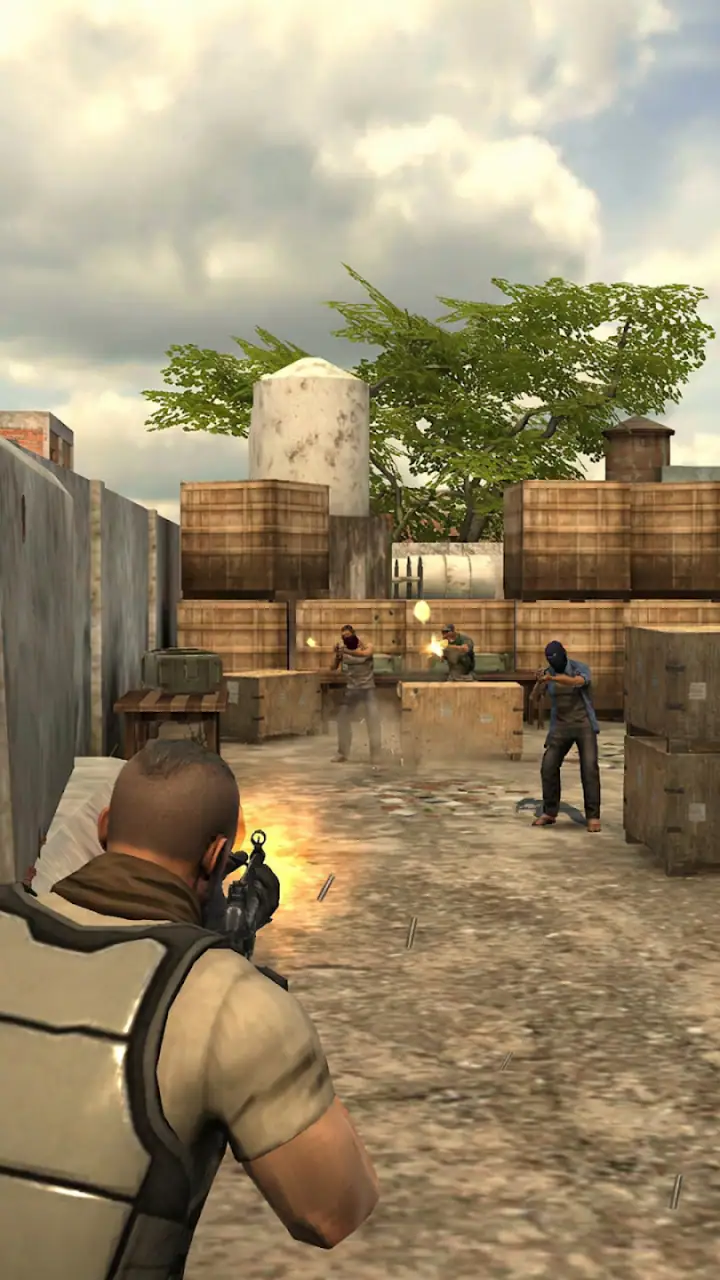
Setup boundaries before the first match
The game runs on Android devices using version 7.0 or later, so compatibility is the first check to make before planning a shared installation. That requirement is relatively broad, but an older compatible phone may still provide a different experience from a newer device. I would leave enough storage and close unnecessary apps before playing, especially if the handset is also used for calls, schoolwork, photos, or other important tasks.
I also recommend deciding who will handle the initial installation and any later changes. The current version is 1.10.0, and keeping software current can be useful, but updates on a shared device should not be treated as an invitation to reset someone else’s arrangement. If the phone belongs to a parent, guardian, or household, that person should remain responsible for downloads, account choices, and payment decisions.
There is another useful boundary: do not confuse the game’s Teen rating with a recommendation for every teenager or every family situation. A rating gives context, but it does not replace a parent’s judgment. The gun-focused theme may be acceptable for one household and unsuitable for another. I would look at the tone of the game personally before allowing a child to play, rather than relying on the category label alone.
For a first session, I would use a quiet moment instead of handing over the device during a rushed situation. That makes it easier to see whether the controls feel comfortable, whether the visual intensity is appropriate, and whether the player understands that purchases are not part of ordinary turn-taking. This initial check is more valuable than assuming that every action game handles shared use in the same way.
Coordinating turns without making the game a chore
Coordination works best when it stays simple. In my experience, a household does not need a formal schedule for a game like this; it needs a clear agreement about whose turn it is and when the device must be returned. A short timer or a fixed number of rounds can prevent one player from occupying the phone indefinitely, particularly when the game is being used on a device that other people need for communication.
I would also keep the device owner in charge of any account-related action. If one person is playing and another person owns the phone, the player should not accept a purchase, change an account setting, or remove the game without checking first. This separation between playing and managing the device is a useful habit because the game is free to start but has optional paid items.
Another practical tip is to avoid promising that everyone will have identical progress. On a common installation, one player’s actions may affect what the next person sees. If that possibility creates tension, the game is better treated as a shared challenge than as several private campaigns. If each player wants independent progress and personal control, a privately managed device is the cleaner option.
Coordination also matters for sound and attention. A first-person shooter can be distracting in a room where someone is studying, working, or resting. I would use a lower volume or headphones where appropriate, while remembering that headphones are not a substitute for checking the content itself. The goal is not to make the game seem more serious than it is; it is to fit it courteously into a shared space.
Age, trust, and the right player
The Teen rating makes this a poor choice for very young children, even if they understand simple touch controls. The central activity is shooting, and that theme should be discussed honestly rather than softened with vague language. I would recommend that a parent or guardian try the game first, then decide whether the tone suits the child, the household’s rules, and the circumstances in which the game will be played.
Trust is just as important as age. A responsible player should understand that a free game can still contain optional spending and that a shared device is not a private account. For teenagers, this can be a useful opportunity to set a clear rule about purchases and respectful use. For younger users, I would keep the device owner involved instead of assuming that the player can manage every prompt independently.
The game’s audience is likely to appreciate direct action more than detailed realism. I would point it toward someone who enjoys mobile FPS games, wants a war-themed setting, and is comfortable with a focused shooting loop. I would steer away from it for a player who prefers peaceful puzzle games, story-heavy adventures, or games designed primarily around cooperation and creativity.
It is also worth considering temperament. Some people enjoy the pressure of aiming and reacting; others find repeated combat tiring or unpleasant. A Teen label does not tell me whether a particular player will enjoy that rhythm. The best test is a supervised first session, followed by an honest question: did the game feel entertaining, or did it simply make the player tense?
Where it stands beside other mobile shooters
Compared with a large competitive shooter, this game is easier to understand as a focused pick-up-and-play option. A major online alternative may offer broader systems, stronger social features, or more long-term progression, but it can also demand more time, more storage, and more attention from the player. I would choose Gun War when I want a simpler entry into three-dimensional shooting without committing to a large gaming routine.
Compared with arcade action games viewed from above or from the side, the first-person perspective gives aiming a more personal feel. That viewpoint is the main reason to choose it over a generic run-and-gun title. The trade-off is that the experience depends more heavily on whether the player enjoys looking, positioning, and firing from that perspective. If touch aiming feels awkward, a different style of action game may be more comfortable.
It also differs from story-led war games. Those alternatives may offer characters, missions, and emotional context, while this title is more immediately about the act of shooting. That makes it convenient for a short break but less satisfying for someone who wants a campaign with a memorable narrative. I would not judge it against a console-scale shooter on depth; I would judge it on how quickly it delivers its central action.
The audience response gives some useful context without changing my personal assessment. The game has a 4.6 average from around 593 ratings, with over 100 thousand installs and 16 written reviews. Those figures suggest that people are finding and rating it, but they do not guarantee that it will suit every device, age group, or playing style. I treat them as a sign of interest, not as a replacement for checking the game’s content and controls myself.
Small decisions that improve the experience
My first tip is to separate the question “Can this device run it?” from “Is this a good shared-device game?” Android compatibility answers only the first question. A phone can meet the minimum operating-system requirement and still be a poor household choice if its owner needs uninterrupted access, if the screen is uncomfortable for aiming, or if several people cannot agree on progress and purchases.
My second tip is to establish a no-purchase rule before the first round. Because each optional item costs $4.99, a player should never treat a payment prompt as part of normal play. On a family device, I would make the rule visible to everyone who uses it and keep approval with the person responsible for the account. This prevents an avoidable disagreement later.
My third tip is to use the game as a trial of interest, not as an automatic long-term commitment. Give the intended player a short, supervised opportunity to decide whether the first-person controls and shooting theme are enjoyable. If the player keeps asking for a different kind of game, that is useful information. There is no reason to force a narrow action title into a household role it was not designed to fill.
A fourth insight is that shared progress can be more important than technical performance. Even if the game runs smoothly, a household may dislike it if one person’s session changes the experience for everyone else. Before installing it on a common device, decide whether the group is comfortable sharing one game state. If not, the better solution is separate devices or a different game with clearer independent profiles, provided those options are available in the household.
Finally, I would review the situation after the first week rather than assuming the initial excitement will last. The game’s focused shooting loop can be appealing in short bursts, but players who need more variety may move on quickly. That is not a failure; it simply means the title works best as a compact action option instead of the only game on a device.
Who should install it, and who should skip it
I think it is worth trying if you want a free mobile action game with a first-person shooting viewpoint, prefer direct controls over elaborate preparation, and are comfortable with a Teen-rated war theme. It is especially suitable for a player who wants something easy to explain to a friend and quick to revisit during spare time. The free price lowers the barrier to testing it, as long as optional spending is handled carefully.
I would skip it if your priority is a calm family game, a rich story, independent profiles for several household members, or a deep simulation of military tactics. I would also skip it for a young child unless a parent or guardian has personally reviewed the experience and decided that it fits the child. The game’s strengths are concentration and immediacy, not broad family accessibility.
For a teenager sharing a parent’s phone, it can work with clear boundaries: play only during agreed times, do not alter another person’s progress, and ask before accepting any paid item. For siblings sharing a tablet, I would be more cautious, because disagreements over turns and progress can outweigh the fun. In that situation, a cooperative or profile-friendly alternative may be a better household choice, even if its action is less intense.
My household verdict
Gun War: 3D Shooting Games is a straightforward action game that earns its place through a clear idea rather than a wide collection of systems. I like it most as a short-session FPS for one player who knows what kind of experience they want. The 3D perspective makes the shooting feel more immediate than many simpler action games, while the free entry point makes experimentation easy.
My recommendation becomes conditional when the game is installed on a shared device. Keep the device owner responsible for installation and purchases, agree on turns, and treat the Teen rating as a reason for an adult to check the content rather than as a universal permission slip. Those steps do not require special family features; they require ordinary communication and trust.
VNGGames Studios has aimed this release at players who want to join a war-themed shooting experience quickly, and that focus is clear. The current version, 1.10.0, is suitable for Android devices running 7.0 or later, while the optional $4.99 items mean households should plan around more than the initial free download. I would recommend giving it a supervised try to the right audience, not installing it automatically for everyone.
In the end, I see it as a good personal action game and a manageable shared-device game only when the boundaries are agreed in advance. If you want quick aiming and shooting in a mobile format, it is a sensible candidate. If you want a peaceful, story-rich, or naturally family-wide experience, I would choose something else. The best reason to install it is focused FPS action; the best reason to pause is the shared-device and age context.
FAQs for Gun War: 3D Shooting Games
What is Gun War: 3D Shooting Games about?
Gun War: 3D Shooting Games is an action-focused mobile shooter built around short missions, enemy encounters, and weapon-based combat. Players move through different environments, eliminate opponents, and work toward completing objectives while improving their equipment. The game is designed for quick sessions, making it suitable for users who enjoy straightforward shooting gameplay without committing to long multiplayer matches.
Can Gun War: 3D Shooting Games be played offline?
Many of the game’s core shooting missions can generally be played without a constant internet connection, which is useful when traveling or when mobile data is limited. However, certain features may require connectivity, including advertisements, updates, online rewards, cloud-related functions, or promotional content. It is best to launch the game once while connected and check which modes remain available offline on your device.
Is Gun War: 3D Shooting Games free to download and play?
The game is typically available as a free download, allowing players to access its main shooting experience without paying upfront. Like many free mobile action games, it may include advertising and optional in-app purchases for upgrades, currency, weapons, or other conveniences. You can usually progress without spending money, although purchases may reduce waiting or speed up equipment improvements.
Is Gun War: 3D Shooting Games suitable for children?
Parents should review the game’s official age rating before allowing children to install it. Because the gameplay centers on firearms, enemy combat, and shooting action, it may not be appropriate for younger players or families seeking nonviolent entertainment. Advertising and optional purchases are also worth checking, so parental controls should be enabled if children use the device independently.
What devices are required to run Gun War: 3D Shooting Games smoothly?
Gun War: 3D Shooting Games should run on many recent Android and iOS devices, but performance can vary depending on the phone or tablet’s processor, memory, operating-system version, and available storage. Older devices may experience slower loading, reduced graphics quality, or occasional stuttering. Before downloading, verify the store listing for the current compatibility requirements and keep sufficient free space for updates.
Pros
- Fast-paced 3D shooting offers quick and satisfying matches.
- Wide selection of weapons keeps combat varied and engaging.
- Simple controls make the game accessible for casual players.
- Short missions suit quick gaming sessions on mobile devices.
- Offline play is useful when you do not have an internet connection.
Cons
- Frequent ads can interrupt gameplay and reduce immersion.
- Weapon upgrades may require considerable grinding or purchases.
- Enemy behavior can feel repetitive after extended play.
- Graphics and animations look dated on some newer devices.
- Limited multiplayer depth may disappoint competitive shooter fans.


